Blogging Tools Guide
Best Free Online Tools for Bloggers: Write Better, Rank Faster, and Grow Smarter
Blogging is not only about writing words. A successful blogger needs SEO tools, keyword research tools, image tools, writing helpers, website checkers, and smart utilities that save time and improve content quality.
Quick summary: The best free online tools for bloggers include keyword research tools, free SEO tools, image converters, grammar checkers, headline analyzers, robots.txt generators, sitemap tools, website traffic checkers, SEO audit tools, broken link checkers, and social media content tools. These tools help bloggers create better content, optimize for a search engine, improve page experience, and boost traffic without spending money.
Why Bloggers Need Free Online Tools
Blogging looks simple from the outside. You choose a topic, write an article, publish it, and wait for readers. But in reality, blogging has many small tasks behind the scenes. You need to search keywords, optimize your title, compress images, check spelling, improve readability, create meta descriptions, inspect broken link issues, analyse your website, understand search results, and make sure your content is easy for users and search engines to understand.
This is where free tools become very useful. A beginner blogger may not have a budget for paid SEO software, premium writing apps, expensive design tools, or advanced website analytics platforms. Free online tools give bloggers a simple way to improve content quality and website performance without paying monthly fees.
Whether you are writing a personal blog, an SEO blog, a niche website, an affiliate blog, or a business blog, the right tools can help you make better decisions. They can help you find keywords for SEO, check keyword search volumes, improve search engine optimisation, and understand what people actually search for before you write.
Image idea for this blog
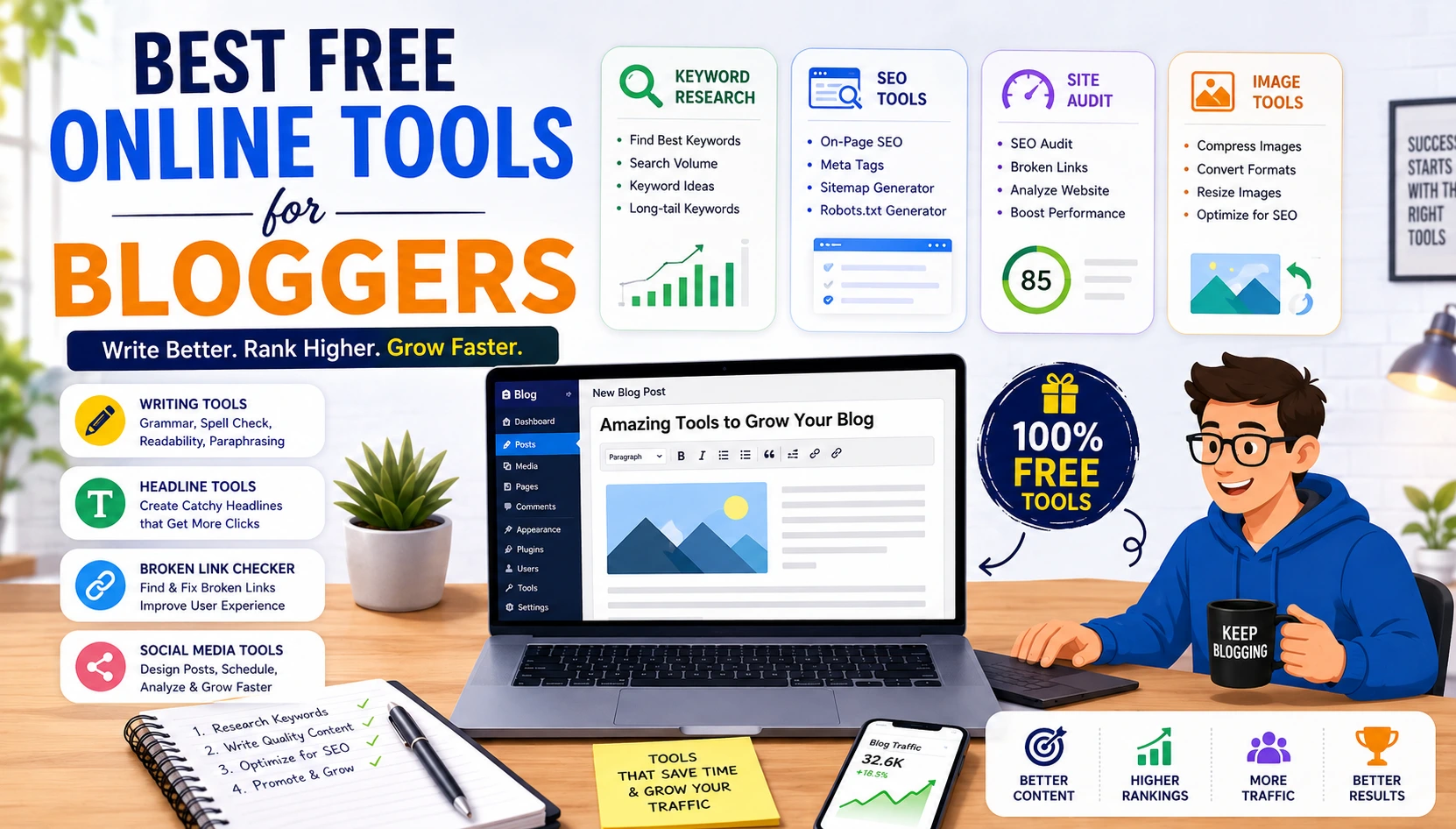
Create a featured image showing a blogger’s desk with a laptop, SEO dashboard, keyword tool, image compressor, checklist, analytics chart, and social media icons. Add the title “Best Free Online Tools for Bloggers” in bold text. This will make the blog look useful, practical, and beginner-friendly.
1. Keyword Research Tools
Keyword research is one of the first steps in blogging. Before writing any article, you should know what your audience is searching for. A keyword tool helps you find topic ideas, search keywords, keyword search volumes, and related phrases that people type into a search engine.
For example, if you want to write about blogging, you may find related keywords like “blogging tools,” “free seo tools,” “keyword research,” “seo tips,” “blog posting sites,” and “how to boost traffic.” These ideas help you create content around real search demand instead of guessing.
You can use a free keyword research tool or free keyword search tools to discover low-competition topics. Beginners often chase very broad keywords, but it is usually better to start with specific topics. Instead of writing only about “SEO,” write about “best free SEO tools for bloggers” or “how to do keyword research for a blog post.”
Useful keyword tool types for bloggers
• Free keyword research tool for topic ideas
• Free keyword analysis tool for checking keyword difficulty and intent
• Google keywords search tool or keyword research tool Google alternatives
• Research tools for finding related questions and long-tail keywords
2. Free SEO Tools
SEO tools help bloggers improve their content for search engines. When people talk about search engine optimisation tools, they usually mean tools that help with keyword planning, title optimization, meta descriptions, sitemap creation, robots.txt files, keyword density, and website checks.
For bloggers, free SEO tools are especially helpful because they reduce guesswork. You can check whether your title is too long, whether your meta description is clear, whether your keyword appears naturally, and whether your page has basic SEO elements. This is important for search engine optimisation SEO, SEO search engine planning, and basic content ranking.
A blogger should not only search for SEO after writing the article. SEO should start before writing. Choose a useful keyword, understand search intent, write a clear title, structure the blog with headings, add internal links, and make the content easy to scan.
Recommended ToolConvertly SEO tool
If you want to create a robots.txt file for your blog, you can use ToolConvertly’s free SEO tool. It helps you generate a clean robots.txt file without writing code manually.
Create Robots.txt File with ToolConvertly3. SEO Audit Tools
An SEO audit helps you understand what is wrong with your blog. A free SEO audit or site audit can show common issues like missing titles, weak meta descriptions, slow pages, missing headings, broken links, and poor internal linking.
For new bloggers, SEO audit tools can feel technical, but they are very useful. A free site audit gives you a checklist of problems to fix. Site audit tools and SEO audit tools can also help you check whether your website is crawlable, mobile-friendly, and properly structured.
You do not need to fix everything in one day. Start with simple improvements: add a proper title, write a clear meta description, improve heading structure, compress images, remove broken links, and add internal links to related posts.
Simple SEO audit checklist
• Check whether every blog post has one clear H1 heading
• Check if the title and meta description are unique
• Check for broken link problems
• Check image size and page speed
• Check whether your important pages are linked internally
4. Website Traffic Checker Tools
Many bloggers want to check traffic of any website because it helps them understand competitors and content opportunities. A website to check traffic can show estimated visits, top pages, traffic sources, and sometimes keyword rankings. These numbers are not always exact, but they can still give useful direction.
For example, if a competitor’s blog gets good traffic from “free seo tools” or “keyword research tools,” you can create a better and more helpful article on that topic. If you notice that list-style posts perform well in your niche, you can write your own version with better examples and clearer explanations.
Website traffic tools are also useful when choosing blog topics. They help you understand whether a topic has demand, whether people search web results for it, and whether the topic is worth your time. But remember, traffic tools are only estimates. Use them as guidance, not as final truth.
5. Image Compression and Conversion Tools
Images make blog posts more attractive, but heavy images can slow down your website. A slow blog can hurt user experience and may affect SEO performance. That is why bloggers should use image compression tools before uploading images.
If your blog uses large JPG or PNG images, compress them and consider modern formats when possible. This helps improve page loading speed and makes the blog smoother on mobile devices. Many readers use phones, so mobile speed is very important.
For every blog image, also add a meaningful file name and alt text. Instead of uploading an image named IMG_2026.jpg, rename it to something useful like best-free-online-tools-for-bloggers.jpg. This helps image SEO and makes your content easier to understand.
Image idea inside the article
Add a comparison image showing one large uncompressed blog image on the left and one optimized lightweight image on the right. Add labels like “Before: Heavy Image” and “After: Optimized Image.” This helps readers understand why image tools matter.
6. Grammar and Readability Tools
A good blog post should be easy to read. Grammar tools help you find spelling mistakes, punctuation errors, repeated words, and unclear sentences. Readability tools help you simplify long paragraphs and make your writing more comfortable for readers.
Bloggers should write like they are explaining something to a real person. Avoid unnecessary jargon. Use short paragraphs. Add examples. Break long sections with headings. A helpful article usually performs better than a complicated article full of difficult words.
This is especially important for SEO blog content. Search engines want to show useful search results. If users quickly leave your page because the article is confusing, it may not perform well over time. Clear writing is part of good SEO.
7. Headline and Title Tools
Your headline is the first thing people see in search results, social media pages, and blog listing pages. A strong headline can increase clicks, while a weak headline can make even good content go unnoticed.
A headline tool helps you improve clarity and emotional value. For example, “Blogging Tools” is too plain. “Best Free Online Tools for Bloggers to Save Time and Improve SEO” is more specific and useful.
When writing titles, include the main keyword naturally. If your topic is about free tools, your title should include “free tools” or “best free online tools.” If your post is about SEO, include “SEO tools,” “free SEO tools,” or “search engine optimisation tools” where it makes sense.
8. Plagiarism and Originality Tools
Original content is important for bloggers. A plagiarism checker can help you make sure your article is not too similar to other pages online. Even if you write your own content, sometimes common phrases may match other websites. Checking before publishing gives you confidence.
But remember, tools should support your writing, not replace your thinking. The best website content comes from real experience, personal examples, useful explanations, and clear structure. If your article only repeats what every other blog says, it will be harder to stand out.
To make your blog better, add screenshots, examples, comparison tables, personal notes, and practical steps. This makes the content more useful for readers and more trustworthy for search engines.
9. Broken Link Checker Tools
Broken links are links that no longer work. They may lead to deleted pages, changed URLs, or websites that no longer exist. Broken link issues can create a poor user experience because visitors click a link and land on an error page.
A broken link checker helps bloggers find and fix these problems. You can remove the broken link, update it with a working URL, or replace it with a better source. This is a simple maintenance task, but it makes your blog more professional.
If your blog has many old posts, check broken links at least once a month. This is especially useful for blogs that link to tools, research sources, tutorials, and external websites.
10. Social Media Content Tools
Publishing a blog post is only the first step. You also need to promote it. Social media pages can help you bring readers from platforms like Pinterest, Instagram, Facebook, LinkedIn, X, and YouTube.
Free social media tools can help you create captions, resize images, design post graphics, plan content, and organize your posting schedule. For bloggers, Pinterest is especially useful because it works like a visual search engine. A good pin can bring traffic for months.
For every blog post, create at least three social posts: one short tip, one quote or checklist, and one direct post linking to the article. This gives your content more chances to be discovered.
11. Robots.txt and Sitemap Tools
Robots.txt and sitemap files are small but important for technical SEO. A sitemap helps search engines discover your important pages. A robots.txt file gives crawling instructions to search engine bots.
For bloggers, this matters because you want search engines to crawl your valuable posts, category pages, and important resources. At the same time, you may want to stop crawlers from wasting time on admin pages, login pages, search pages, or low-value URLs.
If you are not comfortable writing robots.txt rules manually, use a generator. You can create one using ToolConvertly’s free Robots.txt Generator for bloggers. It is a useful tool for anyone learning search engine optimisation, SEO tools, and basic technical SEO.
12. Website Checker and Analysis Tools
A website checker helps you understand your blog’s basic health. You can analyse your website for SEO issues, mobile problems, speed problems, missing tags, and other improvements. This is useful when you are trying to SEO your website and make it more friendly for search engines.
A good website checker does not only show errors. It helps you understand what to improve first. For example, if your website is slow, image compression may be more important than changing your logo. If your titles are missing, fixing titles may be more important than writing new posts.
For beginners, the best approach is simple: check one issue, fix it, then move to the next. Blogging growth comes from small improvements repeated consistently.
How to Choose the Best Free Online Tools for Blogging
Not every free tool is worth using. Some tools are slow, full of ads, confusing, or limited. A good tool should be simple, fast, mobile-friendly, and easy to understand. It should solve one problem clearly.
When choosing tools, ask yourself: does this tool save time? Does it improve my content? Does it help with search engine optimisation? Does it help me understand keyword research? Does it help me boost traffic? Does it make my blog more professional?
For most bloggers, the best tool stack includes a keyword tool, free SEO tools, image compressor, grammar checker, headline checker, SEO audit tool, broken link checker, and social media design tool. You do not need hundreds of tools. You need a few reliable tools that you can use regularly.
Simple blogger tool stack
• Keyword research tool for topic planning
• SEO audit tools for technical checks
• Image tools for speed and page experience
• Grammar tools for clean writing
• Social media tools for promotion
Beginner Blogging Workflow Using Free Tools
Here is a simple workflow you can follow for every blog post. First, use keyword research tools to find a topic. Then search keywords manually in the best search engine or good search engines to understand what type of content is already ranking. Look at the top search results and note what they explain well and what they miss.
Next, create an outline. Add a clear introduction, helpful sections, examples, images, and FAQ. Use free SEO tools to check your title and meta description. Use image tools to compress your featured image. Use a grammar checker before publishing. After publishing, use a website checker or free SEO audit tools to check basic issues.
Finally, share your article on social media pages and blog posting sites. Create pins, short posts, and small summaries. Keep updating the article when you find better information. This is how bloggers grow steadily without depending only on paid ads.
Common Mistakes Bloggers Make with Free Tools
The first mistake is using too many tools and taking no action. Tools are helpful, but they cannot replace writing, publishing, and improving. If you spend all day checking keyword data but never publish, your blog will not grow.
The second mistake is blindly following scores. An SEO score is only a guide. A page with a high score can still be unhelpful, and a page with a lower score can still be useful. Focus on readers first, then optimize.
The third mistake is ignoring search intent. If someone searches “free keyword research tool,” they probably want a tool or list of tools. If someone searches “what is keyword research,” they want an explanation. Your content should match the reason behind the search.
Important SEO Terms Bloggers Should Know
As a blogger, you will often see terms like seo tools, search engine, keyword tool, keyword research, search engine optimisation, seo search engine, search engine optimisation seo, search engine optimisation tools, seo seo tools, search for seo, free keyword research tool, free seo tools, keyword research tools, research tools, search keywords, best search engine, search websites, seo audit, free keyword search tools, seo blog, keyword research tool Google, free SEO audit, SEO tips, SEO keyword research, site audit, SEO audit tools, free site audit, boost traffic, SEO your website, keywords for SEO, free SEO audit tools, free tools, Google keywords search tool, good search engines, search web, keyword search volumes, search results, site audit tools, search engine Google, free keyword analysis tool, Google search engine optimisation, blog posting sites, analyse your website, search keyword research, social media pages, broken link, and look up keywords.
These terms are connected to blogging growth. You do not need to master all of them at once. Start with the basics: find a keyword, write a useful article, optimize the title, add images, check technical issues, and promote the post. Over time, you will understand how each tool fits into your blogging process.
FAQ: Best Free Online Tools for Bloggers
What are the best free online tools for bloggers?
The best free online tools for bloggers include keyword research tools, SEO tools, image compressors, grammar checkers, headline tools, broken link checkers, website checkers, sitemap generators, and robots.txt generators.
Do bloggers need SEO tools?
Yes. SEO tools help bloggers find keywords, improve titles, check website issues, optimize content, and understand how search engines may read their pages.
Can free tools help increase blog traffic?
Free tools can help you improve content quality, find better keywords, fix SEO issues, compress images, and promote content. These improvements can support traffic growth over time.
Which tool should a beginner blogger use first?
A beginner should start with a keyword research tool, a free SEO checker, an image compressor, and a grammar checker. These cover the most important parts of blogging.
How can I create a robots.txt file for my blog?
You can create one manually or use ToolConvertly’s free Robots.txt Generator to generate a clean robots.txt file online.
Conclusion: Build a Smarter Blogging Workflow with Free Tools
Free online tools can make blogging easier, faster, and more professional. They help you research topics, optimize content, improve search engine visibility, fix technical issues, prepare images, and promote posts across different platforms.
The most important thing is to use tools with a clear purpose. Do not collect tools just because they are free. Use a keyword tool to plan content, SEO tools to improve visibility, audit tools to fix problems, image tools to improve speed, and social tools to promote your posts.
If you are a beginner, start small. Pick one blog topic, do keyword research, write a helpful article, optimize it, add images, check basic SEO, and publish. Then repeat the process. Blogging success does not come from one tool or one post. It comes from consistent improvement.
Create SEO Files for Your Blog
Use ToolConvertly’s free Robots.txt Generator to create a clean robots.txt file and improve your blog’s technical SEO setup.
Open ToolConvertly Robots.txt Generator