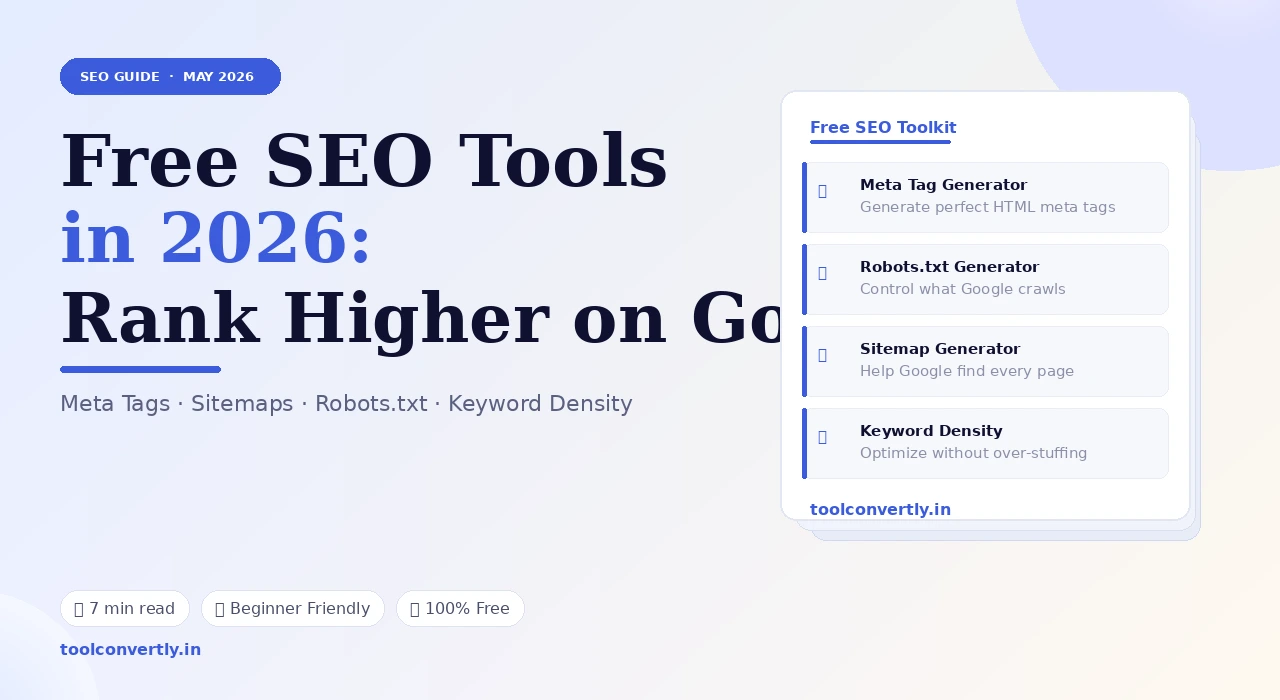
Free SEO Tools in 2025:
The Complete Guide to Rank
Higher on Google
Meta tags, sitemaps, robots.txt, keyword density — everything you need to optimize your website without spending a single rupee.
Getting your website to rank on Google in 2025 is not as complicated as most people think. You don't need a massive budget or a team of specialists. What you do need is a smart set of free SEO tools and a clear, repeatable process. In this guide, we'll walk you through every essential on-page SEO task — and how to complete each one in minutes.
Whether you're a blogger, small business owner, or web developer, bookmark this guide — it'll save you hours every week.
Why On-Page SEO Still Dominates in 2025
Google's algorithms have changed dramatically over the last decade, but one thing has remained constant: on-page SEO signals are foundational to ranking. Technical errors — missing meta tags, broken sitemaps, misconfigured robots.txt files — can silently kill your traffic even if your content is outstanding.
According to Backlinko's comprehensive Google ranking factors study, on-page elements including title tags, meta descriptions, and structured crawl paths remain among the most actionable signals you can directly control. The good news? All of these can be fixed quickly with the right free tools.
Let's break down exactly which tools you need — and how to use them effectively.
1. Meta Tag Generator — Your First Line of SEO Defense
The meta title and meta description are the very first things Google reads — and the first thing your potential visitors see in search results. A poorly written or missing meta description can slash your click-through rate by 30% or more, regardless of your ranking position.
✓ What to check:
- Title tag between 50–60 characters
- Meta description between 150–160 characters
- Focused keyword appears in both
- Every page has a unique meta description
Rather than manually writing meta code and risking syntax errors, use a free Meta Tag Generator to instantly produce clean, properly formatted HTML you can paste directly into your page's <head> section. No guesswork, no errors.
2. Robots.txt Generator — Control What Google Crawls
Your robots.txt file tells search engine bots which pages to crawl and which to ignore. Get it wrong, and you could accidentally block your entire website from Google's index — a catastrophic SEO error that is shockingly common among new website owners.
Common mistakes include blocking CSS or JavaScript files that Google needs to render your pages, or accidentally using Disallow: / which blocks all crawlers completely. A single typo can remove your website from search results overnight.
Use a Robots.txt Generator to select exactly which directories to allow or disallow — no manual coding required. It produces a validated file every single time.
Pro tip: Always submit your robots.txt URL in Google Search Console after making changes, then verify it using the built-in robots.txt Tester inside GSC.
3. XML Sitemap Generator — Help Google Find Every Page
A sitemap is essentially a roadmap for search engines. It tells Google every important URL on your site, when it was last updated, and how frequently it changes. Without a sitemap, newly published pages — especially on large or recently launched websites — can take weeks or months to be discovered and indexed.
Use a free XML Sitemap Generator to automatically build a valid sitemap file. Once generated, upload it to your root domain and submit it to Google Search Console.
Generate your sitemap using the tool and download the XML file
Upload it to your website's root directory via FTP or your file manager
Submit the sitemap URL in Google Search Console under the Sitemaps tab
4. Keyword Density Checker — Optimize Without Over-Optimizing
Keyword density refers to how often your target keyword appears in your content relative to the total word count. In 2025, Google's algorithms are sophisticated enough to penalize both under-optimization and over-optimization — commonly called keyword stuffing.
The sweet spot for most content is a keyword density of 1% to 2%. That means for a 1,000-word article, your primary keyword should appear around 10 to 20 times — naturally woven in, never forced.
Before publishing any article, run it through a Keyword Density Checker to see exactly how your content is balanced. The tool breaks down every term's frequency so you know where to adjust.
⚠ Signs of keyword stuffing to avoid:
- Repeating the exact keyword phrase unnaturally in consecutive sentences
- Using keywords in places they don't make contextual sense
- Listing keywords in footers, image alt text, or hidden elements
- Keyword density consistently above 3%
5. Build Your Complete SEO Workflow — For Free
The biggest mistake website owners make is treating SEO as a one-time task. The truth is, SEO is ongoing. Every new page you publish, every URL you restructure, every blog post needs proper meta tags, sitemap updates, robots configuration checks, and keyword balance reviews.
The good news is you can build a professional, repeatable SEO workflow entirely for free using ToolConvertly's free SEO toolkit. Every tool you need — in one place, no signup required.
Final Thoughts: Start Simple, Stay Consistent
The websites that consistently rank at the top of Google are not always the ones with the biggest budgets — they're the ones that get the fundamentals right, every single time. Proper meta tags on every page. A clean, valid sitemap. A correctly configured robots.txt. Content that hits the keyword balance naturally.
These are not advanced tactics. They're the baseline — and most websites still get them wrong. By using free, reliable tools to handle these technical tasks, you eliminate human error and free up time to focus on what truly matters: creating content that genuinely helps your audience.
Start today. Pick one tool, fix one issue, and build the habit. Your Google rankings will reflect the effort.
Start Optimizing Today
All the Free SEO Tools
You'll Ever Need
No signup. No credit card. No limits. Just fast, accurate SEO tools built for modern websites.
Explore Free SEO Tools →